Archive - May 2000

TEL BEER SHEVA

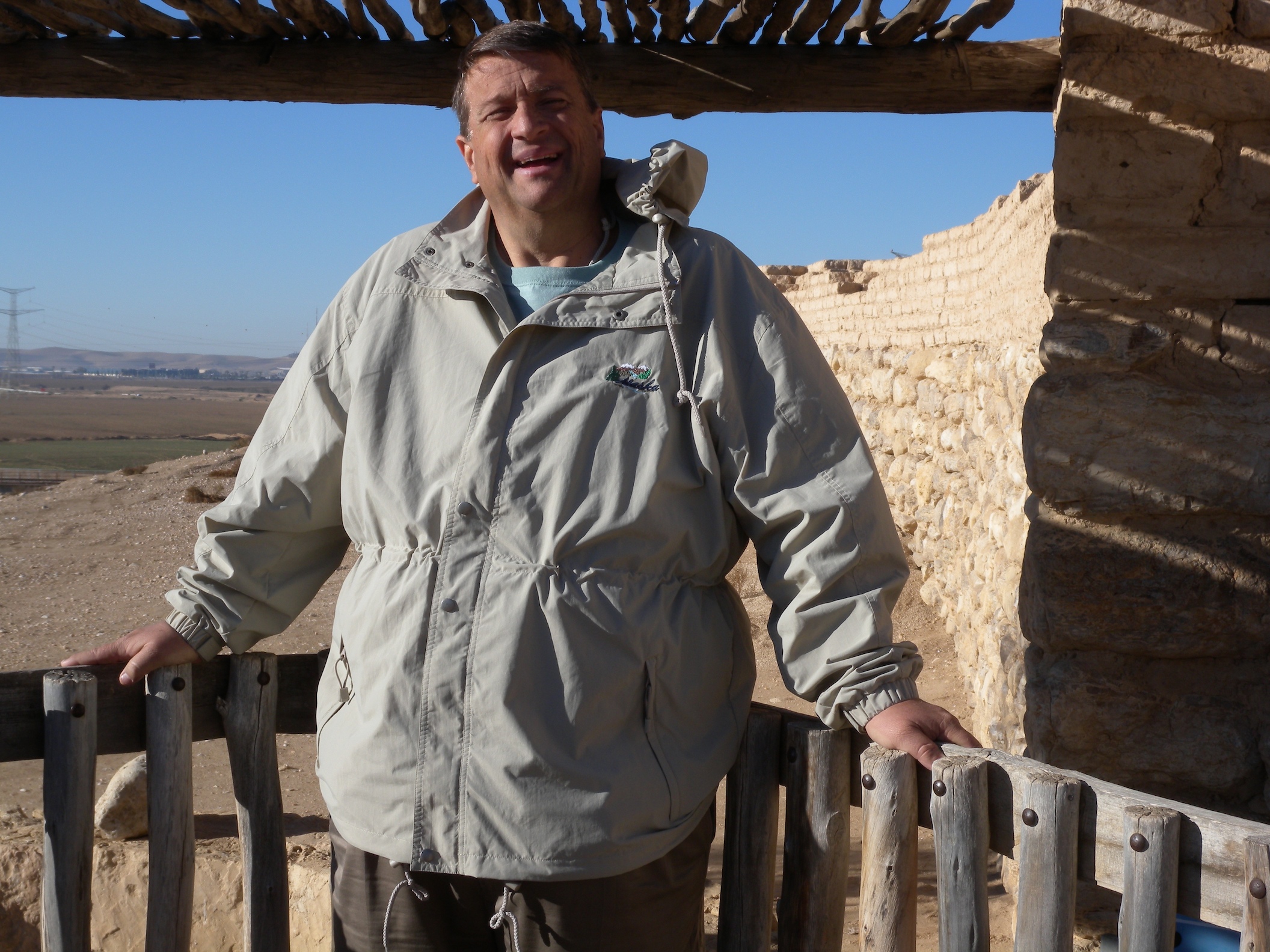
Mike Moskau at Beersheva-Abraham's Well

Tel Beer Sheva
In Judges (20:1) and First Samuel (3:10; 11:17; 24:2) Dan to Beer Sheva’ is a stereotyped expression for the limits of the land of Israel. Beer Sheva’ was important for its association with the Patriarchs. The name is explained as the “Well of the Seven” or the “Well of Oath.” It is a rugged location perched in the Negev Desert just beyond the view of the southern edge of the Judean Mountains.

Tel Beer Sheva is located only a few miles from the modern town of Beer Sheva. It was a place of oath and promise. Abraham found security for his people at the well he dug. Isaac built an altar to the Lord. Jacob received a vision to take his family to Egypt. This was a real frontier settlement where a lot of activity between the Patriarchs and the surrounding nations of the Philistines and Amalekites took place.

King David built up Beer Sheva’s fortifications in the early part of his reign. After the fortifications the city was a lot more tranquil than at any time in its history. Then, it was destroyed by King Shishak and later rebuilt. The next mention of Beer Sheva’ is Amos’ condemnation of the pagan worship. Hezekiah destroyed the altar used at Beer Sheva’s worship center. It did not conform to Biblical directions.

People like religion. The pomp and feel good experience of doing things in a way that doesn’t conflict with their private life. That’s what religion is, rote practice that doesn’t interfere with one’s heart. On the other hand, following Christ is an inner change. Jesus gives us a new heart and makes us new creations.

Abraham worshipped the Lord God. The people of Tel Beer Sheva created a cultic practice of religion that worshipped the creation and not the creator. They liked to do what they wanted to do. They refused to obey the Lord. Cut stones and an altar with horns separated the people of Beer Sheva from a Holy God. Look to your life. Is there some created thing that is separating you from the Lord Jesus?

A walk along the walls offers a spectacular view of Mount Carmel and Haifa, Galilee and the old city. The citadel museum of heroism, built on top of the crusader foundations, commemorates the Jewish freedom fighters imprisoned by the British. Layers of diverse cultures peer through the ancient walls of a subterranean complex, which was excavated in the 1950’S.

The city is more than 4,000 years old. During biblical times the city was under Canaanite control. It is mentioned in ancient Egyptian scrolls from around 1800 BC. The city assumed great importance on the trade route between Egypt and Syria.
 

ACRE (or AKKO)

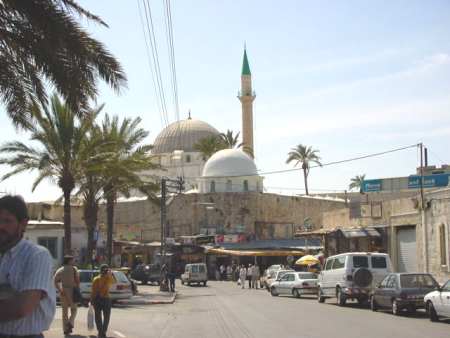
Entering the Old City of Akko

Acre (or Akko), Israel, port 10 mi (16 km) from Haifa across the Bay of Acre.

Greek legend says that Hercules was once seriously wounded here.  He found the herbs to cure his wounds, in this port city and named it Aka for cure.  Greeks settled here in the third century BC.  The name of this 4,000-year-old city appears is spelled many different ways. Officially, it is usually spelled as Acre (in English). However, in Hebrew, the city’s name is pronounced Akko.
Acre was incorporated into the empire of Alexander the Great after his conquest in 332 B.C.  The Egyptian king Ptolemy II subsequently seized the city.   He renamed the city Ptolemais in the 2nd century B.C.  This name stuck until the Muslim conquest in the 7th century A.D.

The Arabs conquered the city in 638 A.D. and developed its natural harbor. In 1104 it was captured in the First Crusade and was held by Christians until 1187 when Saladin took it. It was retaken in the Third Crusade in 1191 and was the center of Christianity in the Holy Land for the next century.

The Ottoman Turks took Akko in 1517 and with the help of the British withstood a 61-day siege by Napoleon in 1799.  British troops captured the city in 1918 and assigned it to the Arabs in the 1948 partition of Palestine.

Israeli forces in the Arab-Israeli war of 1948 captured Acre. By the 1990s its population was about three fourths Jewish and one fourth Arab. The city is a popular tourist site. Landmarks include an ancient citadel, walled fortifications, the al-Jazzar mosque, and several churches dating from the Crusades.
Akko is one of the most dramatic and captivating of Israel’s cities. Within its walls are labyrinthine networks of alleys and streets filled with life.


ABU GHOSH

Abu Ghosh

Abu Ghosh is a bustling, picturesque town located seven miles from Jerusalem, north of the Jerusalem-Tel Aviv highway. Its current claim to fame is that it is the location of several wonderful Middle-Eastern restaurants, Golan-Globus world headquarters and the Elvis gas station.

You would not believe this gas station. It is an interesting stop. The parking lot has two huge statutes of Elvis. Inside the restaurant is one of the largest Elvis collections outside of Graceland. Elvis sings from the speakers night and day.

About now, you’re saying what is this about. You see, Abu Ghosh in Old Testament times was called Qiryat Yearim. It is mentioned frequently in the Old Testament. This was the place where the Ark of the Covenant resided for 20 years (1 Sam 6-7) during the time of Samuel. David brought the Ark of the Covenant from Qiryat Yearim to Jerusalem (2 Sam 6). The Crusaders identified Abu Ghosh as the town of Emmaus mentioned in Luke 24:13-35 where the Risen Christ met two of his disciples.

Abu Ghosh is a beautiful little town without any pretense. One would be ill served in passing this small town to think nothing of it. This is not unlike each one of us. Few of us are called to greatness. Fewer still are even physically fit. But, our claim to greatness is not what we have done but what has been done inside of us. We have recognized our sin and given our hearts to Jesus. The Holy Spirit resides inside of us and is outfitting us for our eternal residence. Now we are weak, clinging desperately by faith to our journey with the Lord. Behind the scenes, in the spiritual realm, our name has been added to the Book of Life and we are in an eternal relationship with the Lord. I am a little person filled with a great God.

TEL ARAD

Tel Arad

Tel Arad is located about 12 miles west of the Dead Sea near the modern town of Arad. It squats atop the highest of a group of low hills as you enter the Negev Desert. This fortress was a strategic outpost for the nation of Israel. It guarded the road to Edom and Elath. You can see the beginning of the Judean Mountains just north of this site. It has a commanding view to the south as you look towards the Negev.

I was very interested in the Holy of Holies located on the southwestern side of the fortress. This is believed to be a replica of the Holy of Holies in the Temple of Jerusalem. It is certainly built as required in Exodus from uncut stone. My question is why did this worship center exist, possibly as early as the reign of Solomon? Its existence is in direct disobedience to the commands of the Lord.

Are we guilty of living in disobedience to the Lord? Is it possible that we could be like the Pharisees and strain out a gnat while we swallow a camel? I have a lot of questions with answers that cause problems. Quite frankly I want to be useful and useable but I must look at my life and make sure that man’s tradition or personal habit does not disqualify me from a vibrant, growing relationship with the Lord.

Israel very seldom stopped worshipping at high places. Their lives were continuously religious but they consistently refused to kneel at the feet of a holy God. Surrender to the Lord and service to their fellow man were not part of their practice. Tradition, habit and fervor for the activities of man filled their lives. Does this sound like the lives of too many Christians? Any wonder that we are losing our relevance in an age of immaturity.